

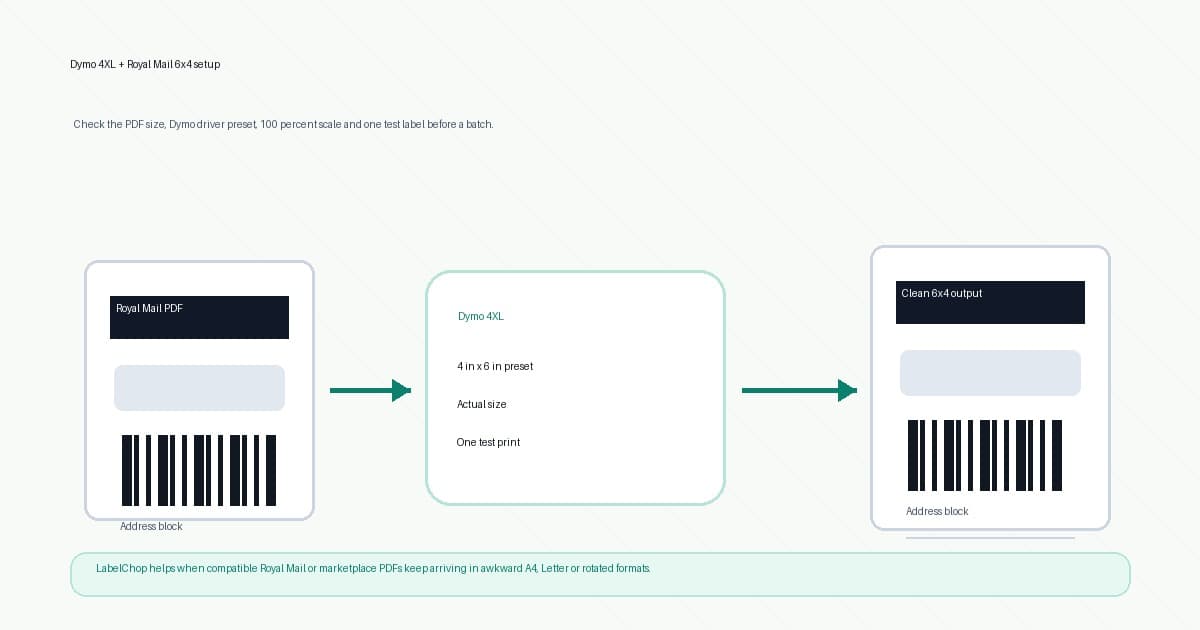
A Dymo 4XL can print Royal Mail labels cleanly, but only when the PDF, Dymo driver and label roll all agree.
The frustrating version looks familiar. You buy postage in Royal Mail or Click and Drop, download a label, choose the Dymo 4XL, then the barcode comes out tiny, clipped or sideways. The printer may be fine. The file and print settings are usually the problem.
This guide is for UK sellers using a Dymo LabelWriter 4XL with Royal Mail, Click and Drop, marketplace exports or other compatible shipping-label PDFs. It focuses on 6x4 thermal printing, A4 PDF traps, Dymo paper-size presets and the checks to run before you waste a batch of labels.
LabelChop helps with compatible Royal Mail PDF workflows, but it is not an official Royal Mail or Dymo integration. Think of it as the PDF cleanup step between your postage workflow and the saved Dymo printer preset.
In this article:
- The quick Dymo 4XL Royal Mail checklist
- Set the Dymo driver before blaming Click and Drop
- Use 6x4, 4x6 or the exact metric stock size
- Check whether the Royal Mail PDF is A4 or label-sized
- Print at 100 percent and inspect one label
- Fix common Dymo 4XL Royal Mail problems
- When LabelChop helps
- Related Royal Mail and Dymo guides
The quick Dymo 4XL Royal Mail checklist
Start here if you are standing at the packing bench.
- Install the current Dymo driver or Dymo Connect software for your computer.
- Load Dymo-compatible direct thermal shipping labels that fit the 4XL.
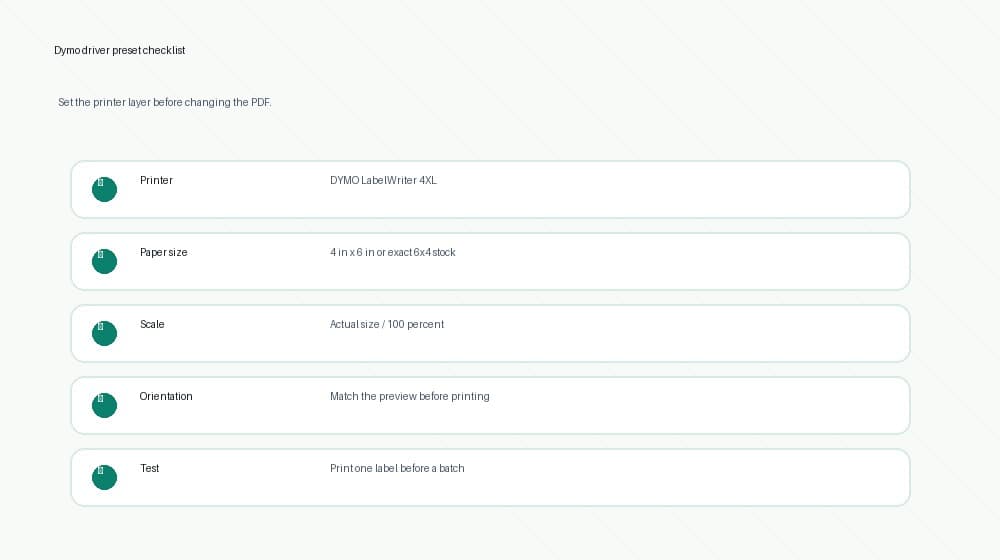
- Set the Dymo printer default to 4 in x 6 in, 6x4 or your exact loaded stock size.
- Create or download the Royal Mail or Click and Drop label PDF.
- Open the PDF and check whether the page is already label-sized or still A4.
- If the PDF is label-sized, print at actual size or 100 percent.
- If the label sits on an A4 page, crop or convert the label area before printing.
- Check orientation in the preview before pressing print.
- Print one test label and inspect the barcode, edges and feed position.
- Save the working preset once the first label is clean.
That order matters because the Dymo 4XL is only following the page and driver instructions it receives. It does not know whether the label came from Royal Mail, Click and Drop, eBay, Shopify, Etsy or another seller workflow.
If you need the broader carrier workflow first, start with the Royal Mail label printer setup guide. If you are choosing hardware, the best label printer for Royal Mail Click and Drop guide explains the buying criteria before this Dymo-specific checklist.
Set the Dymo driver before blaming Click and Drop
A Dymo 4XL can appear in Windows or macOS before the useful shipping-label defaults are actually set.
Open the operating-system printer settings before printing live postage. Confirm the selected printer is the Dymo LabelWriter 4XL, not an office printer, a PDF printer or an old duplicate queue. If your computer added the 4XL with a generic driver and the paper-size list looks wrong, remove the queue, install the Dymo software and add it again.
Check these boring details before changing the Royal Mail side:
- The printer queue name is clearly the 4XL.
- The loaded stock matches the paper size in the driver.
- The labels are direct thermal and loaded the right way up.
- The roll is seated straight and not dragging on the side guides.
- The printer is not paused, offline or sharing a stale queue from another install.
This matters because a good Royal Mail PDF can still print badly through a bad preset. It also keeps you from changing five settings at once and never knowing which one fixed the label.
The Dymo 4XL setup is similar in spirit to the Dymo 4XL USPS 4x6 setup guide. The carrier changes, but the core checks stay the same: driver size, PDF size, scale and one test print.
Use 6x4, 4x6 or the exact metric stock size
UK sellers often describe Royal Mail thermal labels as 6x4. Printer drivers and label suppliers may say 4x6, 100x150mm, 102x152mm or another close shipping-label size.
Use the option that matches the physical labels in the Dymo 4XL. Do not choose A4 just because the downloaded PDF is A4. Do not choose A6 as a rough substitute unless your stock and PDF are actually A6. A few millimetres can be enough to push a barcode too close to the edge.
Use this baseline for Dymo 4XL Royal Mail labels.
| Setting | Choose | Why it matters | |---|---|---| | Printer | Dymo LabelWriter 4XL | Avoids a duplicate queue or office printer | | Paper size | 4 in x 6 in, 6x4 or exact stock size | Matches the loaded label roll | | Scale | Actual size or 100 percent | Stops tiny or enlarged labels | | Orientation | Match the preview | Prevents sideways labels | | Margins | None or minimum where available | Protects barcode quiet space | | Test print | One label first | Catches bad settings before a batch |
If you are unsure which size name to use, read the Royal Mail label size guide or use the Royal Mail 6x4 label settings checker. Those pages explain the 6x4, 4x6, 100x150mm, A6 and A4 naming mess in more detail.
Check whether the Royal Mail PDF is A4 or label-sized
This is the step most sellers skip.
Open the downloaded label before printing. Ask a simple question: is the whole PDF page the label, or is the label sitting inside a larger A4 page?
A label-sized PDF is the easiest case. If the PDF page itself is 6x4, 4x6 or close to 100x150mm, the Dymo 4XL should print it cleanly once the driver matches and scaling is set to actual size.
An A4 PDF is different. The label may be valid, but the page around it is not ready for the 4XL. If you print the whole A4 page onto one thermal label, the Dymo driver has to shrink the entire page. That is how a normal Royal Mail label becomes tiny in the corner.
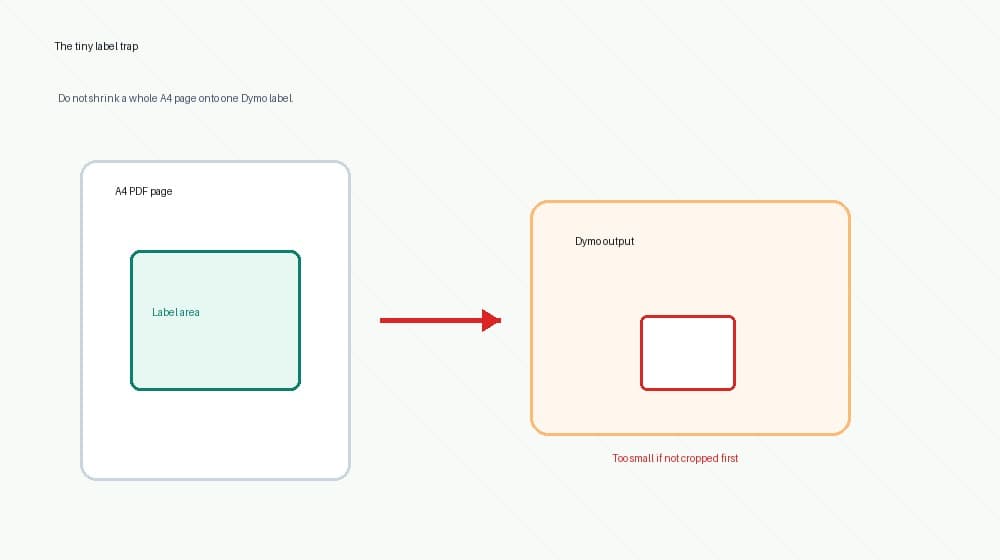
If Click and Drop or your marketplace workflow offers a thermal or 6x4 format, use that first. A native label-sized PDF is cleaner than fixing an A4 page later.
If you already have an A4 PDF, crop or convert the label area before printing. For a one-off rescue, use the free A4 to 4x6 shipping label converter. If you are not sure what size the file is, use the shipping label size checker before changing the Dymo driver again.
Print at 100 percent and inspect one label
For a correct label-sized PDF, use actual size, 100 percent or no scaling. The wording changes between Acrobat, Preview, Chrome, Edge and other apps, but the goal is the same: one PDF page maps to one physical Dymo label.
Avoid these settings for the first test unless you know exactly why you need them:
- Fit to page
- Shrink oversized pages
- Scale to printable area
- Fill entire page
- Browser headers and footers
- Custom margins from a previous office print job
Print one label and look at it properly. The barcode should be sharp. The quiet space around the barcode should still exist. The address should be readable. The label should not clip at the top, bottom or sides. The next blank label should feed to the correct starting point.
If a neutral 4x6 test label fails, fix the Dymo layer first. That means driver, stock, roll loading, calibration or printer queue. If the test label works but Royal Mail PDFs fail, focus on the PDF page size, crop, orientation or scale.
Fix common Dymo 4XL Royal Mail problems
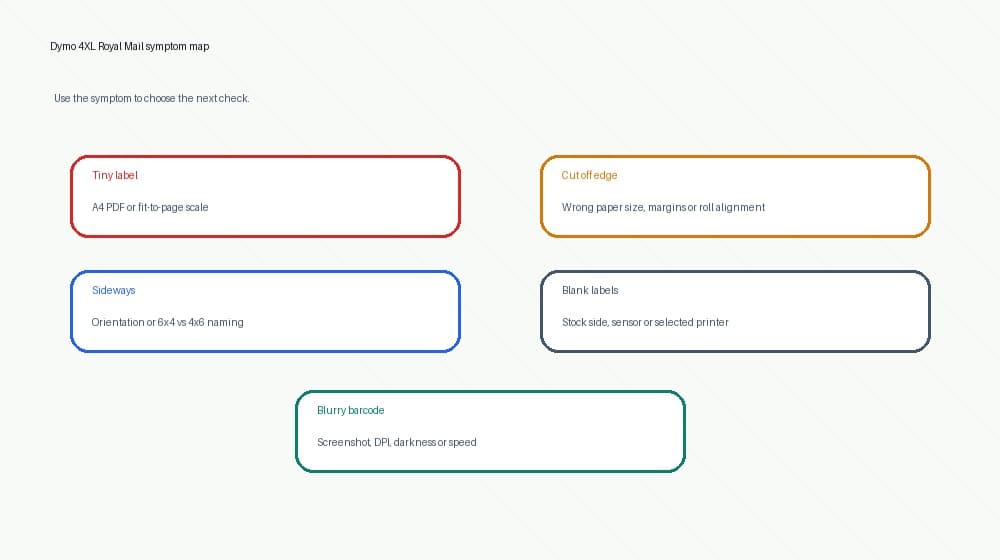
Use the symptom to choose the next check instead of changing random settings.
The Royal Mail label prints tiny
This is usually an A4 PDF or a scale setting.
Open the PDF and check the page size. If the label sits on an A4 page, crop or convert it before printing on the Dymo 4XL. If the PDF is already label-sized, turn off fit-to-page and print at actual size.
The shipping label printing too small guide gives a symptom-first diagnosis if every app seems to shrink the label differently.
The barcode is cut off
Cut-off labels usually point to paper size, margins, orientation or roll alignment.
Set the Dymo driver back to the loaded label size. Check the preview. Then print one test. If the preview is clean but the physical label clips near the same edge each time, check the roll is seated straight and the guides are not pushing it sideways.
For the broader edge-clipping path, use the shipping label cut-off troubleshooting guide.
The label prints sideways
Sideways output usually comes from orientation confusion.
A 6x4 label can be described by height first or width first depending on the app. Do not rotate both the PDF and the driver at once. Change one setting, print one test and keep the result only if the preview and physical label agree.
Blank labels feed through
Blank Dymo output is usually stock, roll direction, sensor or selected-printer trouble.
Check the labels are direct thermal, loaded with the printable side facing the print head and feeding straight. If a printer self-test is blank too, fix the Dymo layer before changing Royal Mail settings. If self-test output works but the shipping label fails, go back to the PDF and app print settings.
Use the thermal printer blank labels checklist if every file feeds blank stock.
The barcode looks blurry
Avoid screenshot workflows.
A screenshot turns a sharp PDF into a lower-quality image, then the print dialog may scale it again. Use the original PDF where possible. If the page size is wrong, crop or convert the PDF instead of pasting the label into Word, Canva or another document editor.
The blurry shipping label barcode guide covers DPI, darkness, speed, print-head cleaning and screenshot quality loss.
When LabelChop helps
LabelChop is not a Dymo driver, Royal Mail account, postage-buying tool or official carrier integration.
It helps when the Dymo 4XL is working, but the files keep arriving in awkward formats. One Royal Mail label may be a clean 6x4 PDF. Another marketplace export may be A4. A returns label may sit in a different part of the page. A browser may remember the wrong print settings from yesterday.
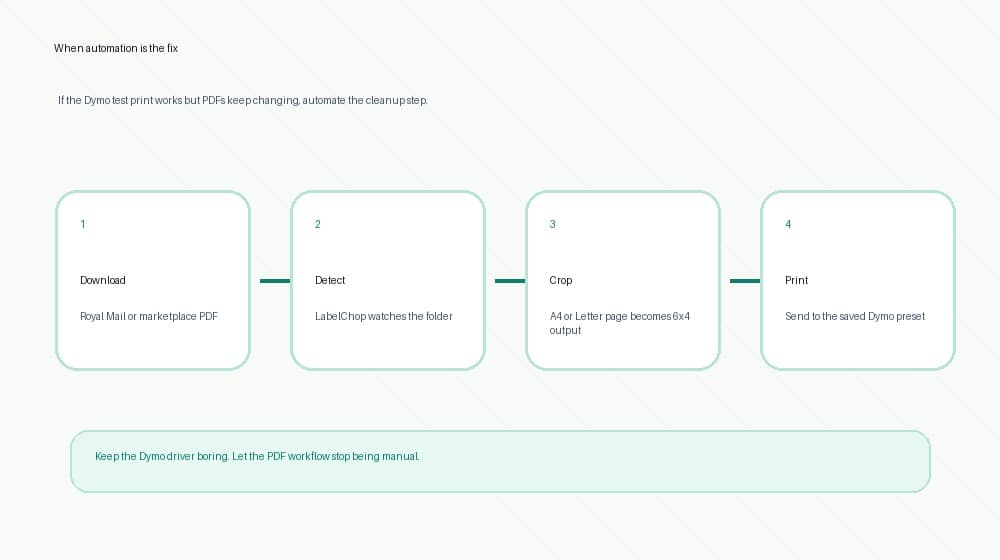
For a one-off file, a manual crop or the free converter is enough. For repeated labels, the manual loop becomes the cost: download, open, crop, choose the Dymo preset, check 100 percent scale, print and repeat tomorrow.
LabelChop watches a folder, detects compatible shipping-label PDFs, crops or resizes awkward pages to 4x6 or 100x150mm output, then prints or saves the cleaned file for your normal thermal-printer workflow.
If you are repeating that PDF cleanup most shipping days, compare the time with LabelChop pricing. If your labels are already native 6x4 and print cleanly, save the Dymo preset and keep the workflow simple.
Related Royal Mail and Dymo guides
Keep this Dymo page connected to the rest of the setup chain.
- Royal Mail label printer setup, for the broader Royal Mail and Click and Drop printer workflow.
- Royal Mail label size guide, for 6x4, 4x6, 100x150mm, A6 and A4 label-size checks.
- Royal Mail Click and Drop label printer workflow, for Click and Drop PDF output and browser-print traps.
- How to print a Royal Mail label at home on 6x4, for the downloaded-PDF home-print sequence.
- Best label printer for Royal Mail Click and Drop, for choosing between Dymo, Zebra, Brother, MUNBYN, Rollo and similar 4 inch printers.
- Dymo 4XL USPS 4x6 setup, for the US version of the same Dymo PDF-size problem.
- A4 to 4x6 shipping label converter, for one-off awkward PDFs before printing.
Once the Dymo driver, Royal Mail PDF, paper size and scale agree, the 4XL should be boring. Save the preset, print one test after any workflow change and stop resizing labels by screenshot.